Showing posts with label search engines tools and news. Show all posts

removal request of your url from search engines


As a site owner, you control what content of your site is indexed in search engines. The easiest way to let search engines know what content you don't want indexed is to use a robots.txt file or robots meta tag. But sometimes, you want to remove content that's already been indexed. What's the best way to do that?

As always, the answer begins: it depends on the type of content that you want to remove. Our webmaster help center provides detailed information about each situation. Once we recrawl that page, we'll remove the content from our index automatically. But if you'd like to expedite the removal rather than wait for the next crawl, the way to do that has just gotten easier.

For sites that you've verified ownership for in your webmaster tools account, you'll now see a new option under the Diagnostic tab called URL Removals. To get started, simply click the URL Removals link, then New Removal Request. Choose the option that matches the type of removal you'd like.


Individual URLs
Choose this option if you'd like to remove a URL or image. In order for the URL to be eligible for removal, one of the following must be true:
The URL most return a status code of either 404 or 410.The URL must be blocked by the site's robots.txt file.The URL must be blocked by a robots meta tag.

 
 Once the URL is ready for removal, enter the URL and indicate whether it appears in our web search results or image search results. Then click Add. You can add up to 100 URLs in a single request. Once you've added all the URLs you would like removed, click Submit Removal Request.

A directory
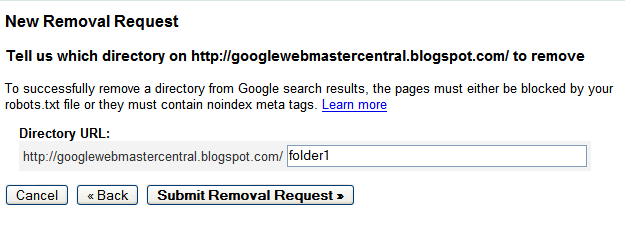
Choose this option if you'd like to remove all files and folders within a directory on your site. For instance, if you request removal of the following:

http://www.example.com/myfolder

this will remove all URLs that begin with that path, such as:

http://www.example.com/myfolder
http://www.example.com/myfolder/page1.html
http://www.example.com/myfolder/images/image.jpg

In order for a directory to be eligible for removal , you must block it using a robots.txt file. For instance, for the example above, http://www.example.com/robots.txt could include the following:

User-agent: Googlebot
Disallow: /myfolder
Your entire site
Choose this option only if you want to remove your entire site from the Google index. This option will remove all subdirectories and files. Do not use this option to remove the non-preferred version of your site's URLs from being indexed. For instance, if you want all of your URLs indexed using the www version, don't use this tool to request removal of the non-www version. Instead, specify the version you want indexed using the Preferred domain tool (and do a 301 redirect to the preferred version, if possible). To use this option, you must block the site using a robots.txt file.

Cached copies

Choose this option to remove cached copies of pages in our index. You have two options for making pages eligible for cache removal.

Using a meta noarchive tag and requesting expedited removal
If you don't want the page cached at all, you can add a meta noarchive tag to the page and then request expedited cache removal using this tool. By requesting removal using this tool, we'll remove the cached copy right away, and by adding the meta noarchive tag, we will never include the cached version. (If you change your mind later, you can remove the meta noarchive tag. )

Changing the page content
If you want to remove the cached version of a page because it contained content that you've removed and don't want indexed, you can request the cache removal here. We'll check to see that the content on the live page is different from the cached version and if so, we'll remove the cached version. We'll automatically make the latest cached version of the page available again after six months (and at that point, we likely will have recrawled the page and the cached version will reflect the latest content) or, if you see that we've recrawled the page sooner than that, you can request that we reinclude the cached version sooner using this tool.

Checking the status of removal requests
Removal requests show as pending until they have been processed, at which point, the status changes to either Denied or Removed. Generally, a request is denied if it doesn't meet the eligibility criteria for removal.


To reinclude content
If a request is successful, it appears in the Removed Content tab and you can reinclude it any time simply by removing the robots.txt or robots meta tag block and clicking Reinclude. Otherwise, we'll exclude the content for six months. After that six month period, if the content is still blocked or returns at 404 or 410 status message and we've recrawled the page, it won't be reincluded in our index. However, if the page is available to our crawlers after this six month period, we'll once again include it in our index.

Requesting removal of content you don't own

But what if you want to request removal of content that's located on a site that you don't own? It's just gotten easier to do that as well. Our new Webpage removal request tool steps through the process for each type of removal request.

 Since Google indexes the web and doesn't control the content on web pages, we generally can't remove results from our index unless the webmaster has blocked or modified the content or removed the page. If you would like content removed, you can work with the site owner to do so, and then use this tool to expedite the removal from our search results.

If you have found search results that contain specific types of personal information, you can request removal even if you've been unable to work with the site owner. For this type of removal, provide your email address so we can work with you directly.
 
If you have found search results that shouldn't be returned with SafeSearch enabled, you can let us know using this tool as well.

You can check on the status of pending requests, and as with the version available in webmaster tools, the status will change to Removed or Denied once it's been processed. Generally, the request is denied if it doesn't meet the eligibility criteria. For requests that involve personal information, you won't see the status available here, but will instead receive an email with more information about next steps.

What about the existing URL removal tool?
If you've made previous requests with this tool, you can still log in to check on the status of those requests. However, make any new requests with this new and improved version of the tool.

Next alternative is to Bing

Have you been itching to try out Bing? Looking longingly at the screenshots around the Web wondering how those lucky few got early access? Wondering who you have to know to get an invite code to check out all your favorite queries?
How about the next best thing? Head over to the BehindBing site at http://www.discoverbing.com/behindbing/ and get all the cool-kids info to help you get ready for Bing's public launch. You can see some behind-the-scenes videos (shot with soft lighting so you know they are serious) featuring some of our engineers, way too much Stefan, live Twitter and Blog feeds so you can see what the world is saying about us (that sounds so narcissistic) and most importantly for some — the Product Guide. It has a bunch of great info on all the features, how to use them once Bing is alive for all, screenshots, and screencasts featuring...yes...more Stefan. It's like I'm a video virus. Get it here!
Enjoy!
Stefan Weitz,
Director,
Bing

What makes a search engine “semantic”? -Dr. Tomasz Imielinski

Recently I took part in a panel discussion at SemTech 2009 on the timely topic of “semanticity” of search engines. In the last few years, many "semantic” search engines have been launched, and the term “semantic” has become open to broad interpretation and use due to the lack of defined industry metrics. It’s a question I’m often asked at conferences: “What qualifies a search engine as semantic?” Is the use of some Natural Language Processing (NLP) technologies sufficient to award such a definition? When can a user say that the search box really understands his or her queries in the same way another human would?
In a new paper entitled, “If You Ask Nicely I Will Answer – Semantic Search and Today’s Search,” which I’ve co-authored with Alessio Signorini, we propose a family of metrics to evaluate the semantical invariance of search engines, and we report experimental results for well-known search engines. I will present and discuss this paper at the IEEE Conference on Semantic Computing (ICSC 2009) this fall in Berkeley.
Here is an abstract of our conclusions, and let me start with an example from our IEEE paper:

Imagine a four-year-old as a human search engine…
Let’s suppose that search engines had the intelligence of a four-year-old child. If that is the case, one could just imagine the following dialogue taking place:
 
User: How is the weather in Hawaii at this time?
Engine: I do not know.
User: What is the weather in Hawaii islands right now?
Engine: I don’t know!
User: OK, “current weather in Hawaii”
Engine:  How many times will you ask the same question?  I told you already, I have no idea!!
Even though that human search engine is entirely clueless about the status of the weather in Hawaii, it is nevertheless semantic: it knows that it does not know. But it does understand that the user keeps asking the same query, although differently phrased.
Humans recognize quickly that two questions can really be simply a different phrasing of the same one. Yet search engines most often don’t understand this.  And until they do, they cannot properly be called semantic.  So, “Top 10 songs”, and then, “Top ten songs” bring different – albeit still relevant – results. But they should not…
It’s not the technology you use, but the effect which you achieve…
How invariant search engine results are under rephrasing (paraphrasing, extra hints, etc.) is, to us, a reflection of how semantic the search engine is.  
It is largely irrelevant how semantic invariance is achieved (i.e. which search technology is used: NLP, statistical analysis of query sessions, etc).  What matters is the final effect.  If semantic invariance is poor, users have to work harder… or – in human terms – they must “ask nicely”. But what that tells us is that search engines are not doing the work they should be.  They are not bearing the burden for the searcher – which they should be.  I believe this can be measured – as we propose in our IEEE paper – by massively testing semantic invariance.
To this end, we propose simple metrics based on the entropy of the results that a search engine returns for clusters of semantically equivalent search queries.  We can measure the overlapping of results (are they stable? does a different URL move to the top if you just ‘ask differently’?).  Does an “ORA” (one right answer), such as “who won the Super Bowl in 2006,” become impacted by how you actually phrase the question?
Here are our conclusions, which we provide in more detail in our IEEE paper:
1. First, the invariance of results for general search queries is still poor. Today’s search engines are very sensitive to the way queries are actually phrased. They are all mostly keyword-based, and far away from simulating human query understanding. 
 
2.  Second, search queries with a “One-Right-Answer” for popular subjects (such as the Super Bowl query) appear to be  well served by today’s search engines, which manage to return the correct answers in their result pages with surprising  invariance to the form or manner of the query.  Unfortunately, this is most likely to be a Pyrrhic victory to today’s engines – because this success is most likely a consequence of the massive redundancy of information on the web.  There are multiple pages talking about the same “facts” in different ways. For topics of massive interest (e.g. the World Cup) many people create pages with the same or similar content. The subtle differences on the language and structure used to present this information help search engines to deliver at least one copy of the information through simple keyword matching.
The recent widespread adoption of Search Engine Optimization (SEO) techniques also plays an important role in this challenge. While those techniques are unfortunately often associated with spam, their original intent was legitimate: help search engines to do a better job while indexing and ranking page contents and URLs.
A truly semantic search engine would take care of invariance at the query level, clustering together all its possible rephrases into one unique concept to each answer, and would deal equally well with popular and unpopular topics (from the World Cup to, say, a small local soccer league in Quito, Ecuador).
The data we collected also confirms that the stability of results under rephrasing for general queries is still poor in all the major search engines. Our experiments with simple numeric synonym replacements (e.g. “10” with “ten”), as well as the ones involving the addition of redundant category terms, indicate the heavy reliance on text matching.
The keywords used in the queries, and their position, strongly influence the distribution and the order of the results returned. This is unacceptable in a semantic world of advanced search engines, where the common goal must be to lift from users’ shoulders the burden of “asking in the right way” to get the right answer.
There’s much more on semantic search you’ll be hearing from me and from Ask in the weeks and months to come.  You can pick up a copy of our paper at IEEE to see what else we found… and look for it here too on the Ask Blog.

Comments:
1) tm lewin voucher discount code : Making search engines semantic is a best way for promotion.

2) wiggles bikes discount code : I was seeking search engine article from Dr. Tomasz Imielinski. thank you.

Search Engine optimizaton is really a balance of what you do and what you do not do. SEO is a process which needs your time, efforts and commitment. You dont do SEO today and reap its award tomorrow. SEO is a constant and consistent process.

With the foreseen changes to happen in the world wide web, all you need to do is be ready. Remember that you are doing SEO for your readers, subscribers or consumers and search engine friendliness follows smoothly when that is your mindset.

Here are simple checklist to serve as a reminder:


  1. SEO is not one time knockout punch but a commitment to improve on a regular basis.


  2. Do not be tired of learning new SEO secrets and techniques. The turnover of technologies is very fast paced and what you know now may not be useful tomorrow. Always go for new skill set.


  3. When hiring an SEO company, ask all you want to ask them.


  4. Patience is an SEO virtue. It will take a few months or so before you see its results.


  5. From the start, make use of web analytics as guide to setting your SEO goals.


  6. Do not forget the basics of website building.


  7. Incorporate the website map page that can aid the search engines spiders to crawl its way ariund your website.


  8. URLs must be SEO friendly. As much as possible, make use of keywords which can easily be recalled by internet users.


  9. At the kick ofof your SEO project, search for keywords that essential for your business or field.


  10. Give your web pages relevant and unique titles and descriptions.


  11. Think of your readers or consumers before thinking of Google, Yahoo! and Bing.


  12. Unique contents never fails. Original content will make you stand out from the rest. Search engines will love you and so will the internet users.


  13. Establish link wisely using reliable and trusted search directories.


  14. Blog search engines love blogs where their spiders can crawl for fresh and well-structured information.


  15. Issue press realese to give your site some exposure. Remember though that there must really be something news worthy or else it will not serve its true purpose.


  16. Be active in social media marketing. Actively participating in different websites will help establish your credibility. Once you are considered as an expert in your niche, word about your website will spread like fire online.


  17. Maximize the opportunity of winning your local traffic. If you own a business, post your number and address where potential clients can contact or visit you.


  18. Take advantages of the free tools that are given by search engines and different websites. This will help you implement SEO without costing you any money.


  19. Diversify where you get your traffic. This will keep you safe from any algorithm updates which may hit your website hard. Grow your market through newsletter, ezines, blogs, social media and local search. Potential clients are all over the place and you should have a very good marketing strategy to get a big chunk.


  20. Always be updated. Keep the list of SEO resources which you can use. Never get tired of looking for new references since SEO will also evolve as search engines, the internet and the users continually evolve. Make sure that you will not be behind SEO race.

    Comments:
    1) Apple iPhone 4 32GB The One Plansearch engine optimization is good trick in promotion. keep it up.

    2) Sony Ericsson T715 Refurbished Text 500 : nice information on SEO. I will follow those steps.


    3) scottish power energy codes discount code : well formatted tools on seo.

Latest trend in search engine optimization

Search Engine Optimization (SEO) is highly dynamic in nature. The trends that worked in the year 2006 may not find relevance in 2007. Various search engines, such as Google, Yahoo!, and MSN Messenger, adopt unique techniques to identify the valuable contents from the spam spreading through the web.
The latest SEO trends focus not only on the keywords/phrases as it had done before, but also on other aspects such as the theme of the website, the social behavior of searching, etc.
Google, the No.1 search engine in the world, uses an algorithm named PageRankTM, a procedure by which it assigns a value to a website according to its relevance to the searched item. Google has now empowered its algorithm with more ‘common sense’ to carry out the tedious task of separating the relevant contents from the spam. The method adopted for this is called Latent Semantic Indexing (LSI).
The LSI is all about categorizing a websites on the basis of its theme. This method effectively eliminates the spam websites that used to stuff their pages with keywords matching the preferences of various search engines. In the advanced search process, Google spiders scan and evaluate the entire content to identify the theme of the website. For example, if a website contains the words such as ‘SEO’ ‘website traffic’, ‘search engine’, etc., repeated in it, it will categorize this website as the one intended for ‘website marketing’. LSI is effective as it gives a ‘sensible’ search result to the visitor. Moreover, it is a great help to webmasters who develop the website in an organic manner (natural means of improving the optimization of the website). To improve SEO under this method, all they have to do is to keep the theme of the website in their mind and supply user-friendly content.
Another latest trend in SEO is the social bookmarking adopted by Yahoo!. Social bookmarking is the process of saving a website link online for further reference. This can be done in both public and private manner. If it is done publicly, the link will be shown to all.
There are many active bookmarking websites; the most popular among them is del.icio.us. Thus social bookmarking can be called as a method of categorizing the most-sought-after pages in the web. In other words, this is a method where the visitors to a website contribute to its optimization.
The process of bookmarking starts with submitting a link to a bookmaking site such as del.icio.us. After submitting a number of links to the bookmarking site, one can export the links to Yahoo MyWeb. Whenever these links in the Yahoo MyWeb appears in their Search Engine Page Result (SERP), they will be displayed with a special status, showing the details of bookmarking, such as the number of visitors to the link. This facility, therefore, automatically improves the SEO. However, there are spammers who abuse social bookmarking, and of course, Yahoo! has confronted them effectively by introducing ‘no follow’ commands to the links added to it.
Both methods, LSI and social bookmarking, are the latest ethical practices of SEO. However, the conventional practices that rely on keyword density and inbound links, still find relevance in Google. The basic idea of all SEO processes is to encourage the websites that share the relevant contents to the visitors. Good Luck!

Comments:
1) t.m lewin shirts discount codes : marvelous information for seo.


2) thomson holidays late deals discount code : hope to get much more information too and regular update in your page.

Optimization of web Page

Why is it important to optimize your web pages?
By optimizing your web pages, you tell search engines for which keywords you want to be found.
If you do not optimize your web pages, then search engines won't list your website or they will list it for the wrong keywords.
Optimizing your web pages makes sure that your website can get high rankings for the keywords of your choice.

How to optimize your web pages?
High rankings on Google and other search engines are the result of optimized web page content and good incoming links. Start with optimizing your web page content.
By optimizing your web page content, you tell search engines for which keywords you want to be found. Search engines can only give your web page a high ranking for a certain keyword if your web page is relevant to that keyword. Make sure that your web pages don't have major HTML code errors that prevent search engines from indexing your site.
What can happen if you do not optimize your web pages?
If you do not optimize your web pages then search engines might not be able to index your pages. In addition, search engines might not be able to find out what your web pages are about.
If you optimize only one web page of your site then it will be very difficult to get high search engine rankings. Search engines take your complete website into account. If you have many web pages that are optimized for different but related keywords than search engines will think that your web pages are relevant to a certain topic.
Relevant web pages get better search engine rankings. For that reason, you should optimize as many pages as possible for different but related keywords.
Some HTML errors can prevent search engines from indexing your web pages. If your web pages have such an HTML error, you won't get listed on search engines because search engines cannot index your pages. For that reason, it is also important to check the HTML code of your pages.

Why are inbound links important?
Links are one of the most important factors for high search engine rankings. It is not possible to get high search engine rankings without good incoming links!
The idea behind this concept is that search engines think that your website must be important if many other websites link to your site. The more other websites link to your website, the higher your search engine rankings will be.
If more than one website has been optimized for the same keyword, then the page with the best incoming links will get the highest search engine rankings.
You should optimize at least six different pages of your website for different but related keywords. Do not optimize the same page for more than one or two keyword phrases.


How to optimize your inbound links?
High rankings on Google and other search engines are the result of optimized web page content and good incoming links. You need both to get high search engine rankings.
The number of links alone is not enough to improve your search engine rankings. It is also important that the other websites are related to your website. If the links to your website include your important keywords in the link text, then it's easier to get high rankings for these keywords.
If the links to your site include your keywords, then search engines will think that your website must be relevant for these keywords.

What can happen if you do not build inbound links?
It is impossible to get high rankings on Google or other major search engines without good inbound links. It is absolutely crucial to the success of your website that you work on the inbound links to your site.
Inbound links are extremely important for modern search engines. You cannot get high search engine rankings without good inbound links.

Search Engine Optimization


Search engine optimization (SEO also search optimization) is the process of editing and organizing the content on a webpage or across a website to increase its potential relevance to specific keywords on specific search engines and importantly ensuring that external links to the site are correctly titled and in abundance. This is done with the aim of achieving a higher organic search listing and thus increasing the volume of targeted traffic from search engines.
SEO is one of the key Web Marketing activities and can target different kinds of searches, including image search, local search, and industry-specific vertical search engines.
SEO considers how search engines work and what people search for. Optimizing a website primarily involves editing its content and HTML coding to both increase its relevance to specific keywords and to remove barriers to the indexing activities of search engines. Sometimes a site's structure (the relationships between its content) must be altered too. Because of this it is, from a client's perspective, always better to incorporate Search Engine Optimization when a website is being developed than to try and retroactively apply it.
There are two basic reasons to submit a web site or web page to a search engine. The first reason would be to add an entirely new web site because the site operators would rather not wait for a search engine to discover them. The second reason is to have a web page or web site updated in the respective search engine.

Here are some links for you to promote your page, sites and blogs for free of cost:


FFA submit List:
http://www.lsblogs.com/add_url.php?c=5
http://lucknowwebs.com/templates/classified/classifiedportal/add_url.php?c=2
http://www.lyricalbruce.net/2007/modules.php?name=Web_Links&l_op=AddLink
http://www.macmusic.org/links/add.php?lang=en
http://www.mathfanatics.com/mathlinks/add_url.php?c=1
http://mctaggartmedia.com/add.php
http://www.megawhite.com/cgi-bin/add.cgi
http://www.metrokarges.com/cgi-bin/links/cougalinks.cgi?action=add-url
http://www.mhhe.com/cgi-bin/links/add.cgi
http://www.minelinks.com/cgi-bin/s/search.pl?Mode=AnonAdd
http://www.mineralsites.com/index.php?do=basic
http://www.miodirectory.com/add_url.php?c=4
http://www.mobitola.com/add_url.php?
http://www.scriptsgalore.net/directory/models-int/links.php?ax=add
http://www.moldnews.org/cgi-bin/links/cougalinks.cgi?action=add-url
http://momof2boys.com/TheDirectory/add.php